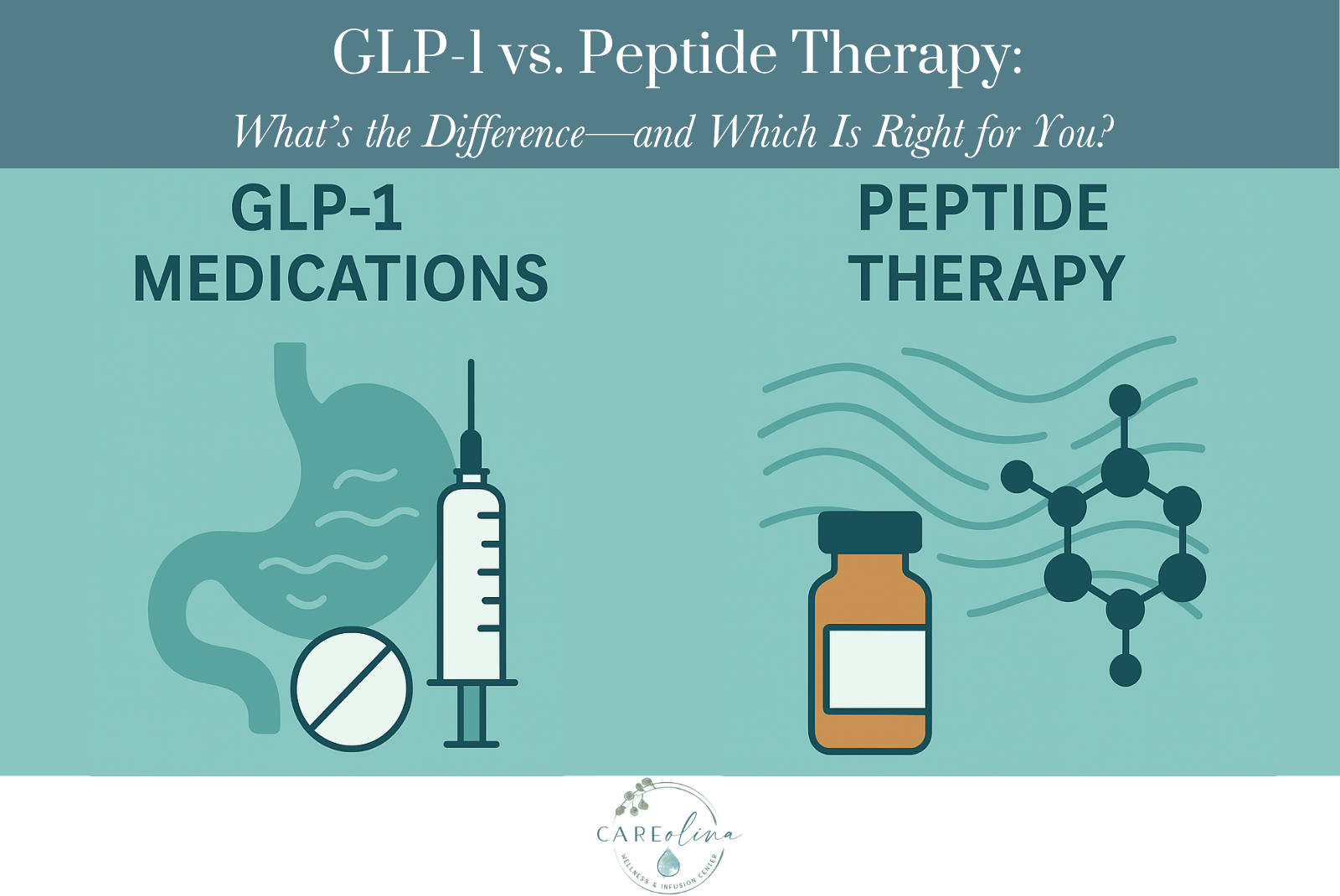
If you’re exploring non-surgical options for weight management, metabolic health, and recovery, you’ve likely heard two terms a lot lately: GLP-1 (weightloss) and peptide therapy (like CJC-1295/Ipamorelin, BPC-157, and others). Both involve bioactive peptides, but they work differently, target different goals, and follow very different evidence and regulatory pathways.
At CAREolina Wellness and Infusion Center in Winston-Salem, we help you understand the nuances so you can choose a plan that matches your health history, goals, timeline, and budget—always paired with sensible nutrition, movement, sleep, and stress strategies.
Quick Summary
- GLP-1 medications are FDA-approved prescription drugs for type 2 diabetes and/or chronic weight management. They act on gut-hormone pathways that regulate appetite, gastric emptying, blood sugar, and energy balance. Robust clinical evidence supports significant weight loss and cardiometabolic benefits for eligible patients.
- Peptide therapy is a broader category of compounded peptides used to support recovery, sleep, cognition, body composition, skin health, or healthy aging (e.g., CJC-1295/Ipamorelin for growth hormone signaling, BPC-157 for soft-tissue support). Evidence ranges from promising to preliminary depending on the peptide and indication; most are not FDA-approved for the marketed wellness uses.
Think of GLP-1s as disease-targeted, highly studied medicines, and “peptide therapy” as a toolbox of smaller-studied biologic signals used for performance, recovery, and healthy aging goals.
How GLP-1s Work
- Mechanism: Mimic or enhance incretin hormones (GLP-1) to reduce appetite, slow gastric emptying, improve insulin secretion, and lower blood glucose.
- Primary uses: Type 2 diabetes management; chronic weight management in eligible adults with obesity or overweight + a weight-related condition.
- Clinical outcomes: Significant average weight loss, improved A1C, favorable effects on some cardiovascular risk markers in appropriate patients.
- Form & dosing: Mostly weekly injections; some daily or oral options exist depending on the drug.
- Common side effects: Nausea, fullness, reflux, constipation/diarrhea; typically improve with gradual dose titration and lifestyle support.
- Important cautions: History of medullary thyroid carcinoma (MTC) or MEN2, pancreatitis, gallbladder disease, severe GI disorders, certain drug interactions, and pregnancy/breastfeeding considerations.
How “Peptide Therapy” Works (Examples)
“Peptide therapy” is an umbrella term. Popular options and their typical goals include:
- CJC-1295 / Ipamorelin: Signals the pituitary to support growth hormone pulsatility—used in programs targeting body composition, recovery, and sleep quality.
- BPC-157: Investigational peptide often discussed for soft-tissue support and gut lining integrity in wellness circles.
- Thymosin beta-4 (TB-500): Recovery and tissue-support claims in performance settings.
- NAD⁺-related protocols (not a peptide but often grouped with them): Cellular energy and cognitive support.
Evidence strength varies by compound; many applications are off-label or wellness-oriented rather than FDA-approved treatments for disease. Quality sourcing and clinician oversight matter.
GLP-1 vs. Peptides: Side-by-Side
| Feature | GLP-1 Meds | “Peptide Therapy” (e.g., CJC/Ipamorelin, BPC-157) |
| Regulatory status | FDA-approved for specific indications | Usually not FDA-approved for wellness indications |
| Main goals | Weight loss, glucose control, metabolic risk reduction | Recovery, sleep, body composition, joint/soft-tissue, healthy aging (varies) |
| Evidence base | Large clinical trials with robust outcomes | Mixed/early evidence; varies widely by peptide |
| Onset & magnitude | Often substantial weight loss over months | Gradual/subtle changes; goal-dependent |
| Delivery | Rx injection (weekly common), some oral | Injections, orals, topicals—varies by peptide |
| Side effects | GI symptoms most common; known cautions | Generally mild; depends on peptide and quality |
| Insurance | Sometimes covered for approved indications | Typically cash-pay |
Who Might Consider Each?
- GLP-1 Candidates:
- Adults with obesity (BMI ≥30) or overweight (BMI ≥27) plus a weight-related condition (per labeling), or type 2 diabetes.
- Patients who have tried lifestyle changes and want evidence-based pharmacologic help.
- Those open to weekly injections and structured follow-up.
- Adults with obesity (BMI ≥30) or overweight (BMI ≥27) plus a weight-related condition (per labeling), or type 2 diabetes.
- Peptide Therapy Candidates:
- Individuals focused on recovery, sleep, lean mass, body composition support, or joint/soft-tissue comfort.
- Those who prefer adjunctive wellness tools and understand the off-label/variable evidence nature.
- Patients who are not candidates for GLP-1s or want additional support alongside lifestyle changes.
- Individuals focused on recovery, sleep, lean mass, body composition support, or joint/soft-tissue comfort.
Many clients combine approaches sequentially or strategically (e.g., use GLP-1s for 6–12 months to reach a metabolic milestone, then taper while layering peptide protocols to support maintenance, sleep, and recovery). We customize this with careful supervision.
What Care Looks Like at CAREolina
- Comprehensive Intake: Medical history, medications, labs, goals, and preferences.
- Personalized Roadmap: Clear plan covering nutrition, movement, sleep, stress, and the least-intensive therapy likely to work.
- Medication & Peptide Options: We discuss pros/cons, safety, and costs for GLP-1s and peptide therapies (when appropriate).
- Titration & Support: Slow-and-steady GLP-1 dosing to minimize side effects; peptide protocols designed for simplicity and adherence.
- Maintenance Strategy: Tools to preserve results—habit coaching, labs, and (if helpful) targeted peptides during or after GLP-1 therapy.
Frequently Asked Questions (FAQ)
Q1: Isn’t GLP-1 medications itself a peptide?
A: Yes. Biochemically, GLP-1 medications are peptides. In common use, though, people say “GLP-1” to mean FDA-approved incretin drugs for weight/diabetes, and “peptide therapy” to mean other wellness-oriented peptides used off-label for recovery, sleep, and healthy aging.
Q2: How fast will I lose weight on a GLP-1?
A: Expect gradual, compounding changes across months. Results vary with dose, adherence, lifestyle, and starting health. We titrate slowly to improve comfort and sustainability.
Q3: Can I stop GLP-1s once I reach my goal?
A: Possibly—with a plan. Weight often drifts back without supportive habits. We focus on behaviors, resistance training, protein targets, sleep, and—when appropriate—peptide support during taper to help maintain results.
Q4: Do GLP-1s work if I don’t change my diet?
A: They work best with simple nutrition structure (adequate protein/fiber, hydration) and movement. Medication amplifies your effort; it doesn’t replace it.
Q5: Are compounded GLP-1s safe?
A: We prioritize quality and transparency. FDA-approved products are preferred when available and appropriate. If compounding is considered, we discuss sourcing, documentation, and risks so you can make an informed choice.
Q6: Who shouldn’t use GLP-1s?
A: People with a personal or family history of MTC or MEN2, prior pancreatitis, certain gallbladder or severe GI disorders, and those pregnant/breastfeeding should avoid or use only with specialist guidance.
Q7: What side effects are most common with GLP-1s—and how do you manage them?
A: Nausea, fullness, reflux, constipation/diarrhea. We use low-and-slow titration, hydration/electrolytes, fiber/protein timing, and meal-size adjustments. Most patients acclimate over time.
Q8: What can peptide therapy help with?
A: Depending on the peptide: sleep depth, recovery from training, body composition support, joint/soft-tissue comfort, skin quality, or cognitive clarity. We match the peptide to a clear, measurable goal.
Q9: Is peptide therapy legal?
A: Many peptides are available legitimately via compounding pharmacies for clinician-directed use, though they are not FDA-approved for most wellness indications. We adhere to current regulations and ethical sourcing.
Q10: Will insurance cover these treatments?
A: GLP-1s may be covered for approved indications (criteria vary by plan). Peptide therapy is typically cash-pay. We’ll provide transparent pricing and help you navigate benefits.
Q11: Can I combine GLP-1s with peptide therapy?
A: Often, yes—with medical oversight. For example, CJC-1295/Ipamorelin for sleep/recovery while on a GLP-1, or BPC-157-style protocols around soft-tissue comfort when training increases. We individualize based on labs and symptoms.
Q12: What labs or monitoring do you recommend?
A: Baseline A1C/fasting glucose, lipids, CMP, and other markers as indicated. For peptide programs, we may monitor IGF-1, sleep metrics, body comp, and subjective outcomes tied to your goals.
Q13: I’m not sure where to start.
A: Start with a consultation. We’ll clarify your goals (e.g., energy, appetite control, joint comfort, body composition), review your history, and recommend a stepwise plan—often beginning with lifestyle foundations, then layering medications or peptides as needed.
Why Choose CAREolina Wellness and Infusion Center?
- Safety-first, evidence-forward guidance for GLP-1s.
- Thoughtful, individualized peptide protocols where appropriate.
- Lifestyle coaching that makes results stick.
- Transparent pricing and ongoing support.
- Collaborative care with your primary or specialist when needed.
Ready to Personalize Your Plan?
CAREolina Wellness and Infusion Center
1332 Westgate Center Drive
Winston-Salem, NC 27103
Phone: (336) 999-7116
Website: https://careolinawellnes.doctormmdev7.com/
Book Online: https://careolinawellness.janeapp.com/
Schedule a consultation to compare GLP-1 medication and peptide therapy options for your goals, review safety and costs, and leave with a clear, sustainable plan.